How to Use a Hair Mask Correctly: Best Method for Dry, Damaged & Growth-Focused Hair
Learn how to use a hair mask the right way. Step-by-step guide for dry, damaged, and growth-focused hair, including protein, keratin, bonding, heat and color protection.
HAIR MASK
1/4/20265 min read


How to Use a Hair Mask: The Right Way for Dry, Damaged & Growth-Focused Hair
Hair masks are often described as a must-have treatment for dry or damaged hair, yet many people are unsure how to use them correctly. When applied improperly, even the best hair mask can underperform. When used the right way, however, a hair mask can dramatically improve softness, strength, manageability, and long-term hair health.
This guide explains how to use a hair mask properly, how often to use one, how long to leave it on, and how different formulas—such as a hair mask for dry hair, hair mask for damaged hair, or hair mask for growth—fit into a complete routine.
What Is a Hair Mask and Why Is It Different from Conditioner?
A hair mask is a concentrated treatment designed to work deeper and longer than a regular conditioner. While conditioners smooth the hair quickly and are meant for frequent use, hair masks are formulated to provide intensive conditioning, repair support, and strengthening benefits.
A properly formulated hair mask helps:
Restore moisture to dry hair
Improve elasticity and flexibility
Reduce breakage and split ends
Support weakened hair fibers
Protect hair from heat and color stress
This makes hair masks especially beneficial for people dealing with dryness, damage, frequent heat styling, or chemical treatments.
Hair Mask for Dry Hair: Why Moisture Comes First
Dry hair is one of the most common reasons people reach for a hair mask. When hair lacks moisture, it becomes rough, brittle, and more likely to snap.
A hair mask for dry hair works by replenishing hydration inside the hair shaft and smoothing the outer cuticle. This improves softness and slip, making hair easier to detangle and style.
Key benefits of using a hair mask for dry hair include:
Reduced frizz and rough texture
Improved shine and smoothness
Better elasticity and flexibility
Less breakage during brushing
Dry hair that is properly hydrated is far more likely to retain length over time.
Hair Mask for Damaged Hair: Repair Before Growth
Damage caused by heat styling, coloring, bleaching, or chemical treatments weakens hair internally. A hair mask for damaged hair focuses on strengthening compromised strands and improving resilience.
Damaged hair often feels:
Weak or stretchy when wet
Rough or dull
Prone to split ends
Difficult to detangle
Using a targeted hair mask helps stabilize damaged fibers so hair can tolerate daily stress without breaking.
Hair Mask with Protein vs Hair Mask with Keratin: What’s the Difference and When to Use Each
Not all hair masks work the same way. While some formulas focus primarily on moisture, others are designed to improve strength, resilience, and structural support. Two of the most commonly discussed strengthening categories are hair masks with protein and hair masks with keratin. Although they are often grouped together, they serve slightly different purposes and are best used in different situations.
Understanding the difference helps you choose the best hair mask for your hair type, damage level, and growth goals.
Hair Mask with Protein: Strength for Weak, Fragile Hair
A hair mask with protein is designed to reinforce hair strands that have become weak due to damage, over-processing, or repeated mechanical stress. Hair is primarily made of protein, and when it is exposed to heat, coloring, bleaching, or environmental wear, small gaps and weak points form along the hair shaft.
Protein-based masks help by temporarily filling these weakened areas, improving the hair’s ability to withstand tension.
Best suited for:
Hair that feels limp, mushy, or overly soft when wet
Hair that stretches excessively before breaking
Fine or fragile hair prone to snapping
Chemically treated or over-processed hair
Choosing the Right Mask for Long-Term Results
If your goal is healthier-looking growth, the ideal routine balances:
Strength (protein or keratin)
Moisture (hydration and softness)
Elasticity (flexibility under tension)
The best hair mask for growth is not the strongest one—it is the one that keeps hair strong and flexible, so it can grow longer without breaking.
Hair Mask for Bonding, Heat Protection & Color Protection
Modern hair routines expose hair to repeated stress, which is why many masks now offer targeted benefits.
A hair mask for bonding supports internal hair connections that give hair strength and elasticity.
A hair mask for heat protection helps hair tolerate blow-drying, straightening, and curling by improving moisture balance and flexibility.
A hair mask for color protection helps reduce dryness and fading caused by coloring or bleaching.
These benefits help hair remain stronger and healthier over time.
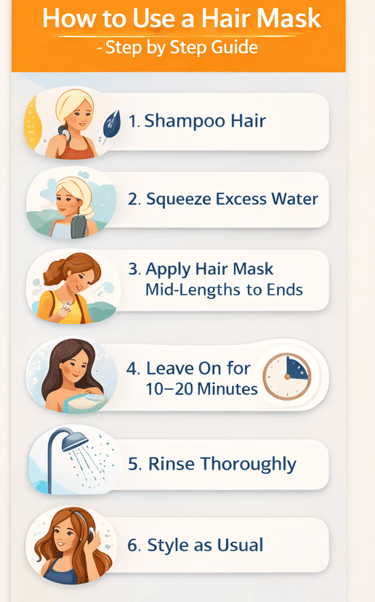
How to Use a Hair Mask Correctly (Step-by-Step)
Using a hair mask properly makes a significant difference in results. Follow this method for best performance.
Step 1: Shampoo First
Always apply a hair mask to clean hair. Shampoo removes oil, dirt, and buildup so the mask can absorb evenly.
Step 2: Remove Excess Water
Gently squeeze out excess water. Hair should be damp, not dripping. Too much water can dilute the mask.
Step 3: Apply from Mid-Lengths to Ends
Apply the hair mask evenly from mid-lengths to ends, where hair is typically driest and most damaged. Avoid heavy application at the scalp unless directed otherwise.
Step 4: Leave On for 10–20 Minutes
Fine or lightly damaged hair: 10 minutes
Dry, damaged, or thick hair: 15–20 minutes
This allows enough time for conditioning and repair support.
Step 5: Rinse Thoroughly
Rinse with lukewarm water until hair feels clean and smooth. Proper rinsing prevents residue and buildup.
Step 6: Skip Conditioner
For most hair types, an additional conditioner is not needed after a hair mask.
Step 7: Style as Usual
Hair should feel soft, smooth, and manageable—not heavy or greasy.
How Often Should You Use a Hair Mask?
Frequency depends on hair type and condition:
Dry or damaged hair: 1–2 times per week
Fine or sparse hair: Once per week
Heat-styled or color-treated hair: Once per week
Consistency matters more than frequency.
Choosing the Best Hair Mask for Your Hair Type
The hair mask best for you depends on:
Hair density (fine vs dense)
Damage level (dry, heat-styled, color-treated)
Need for moisture vs protein
Styling habits
Matching the mask to your hair type prevents heaviness or stiffness.
A Professional Option to Consider
For those seeking a professional deep-conditioning option designed around hair density, Curaphy offers two targeted masks that fit naturally into dry, damaged, or growth-focused routines.
Curaphy Professional Deep Conditioning Hair Mask – Light Hair
Key Features
Lightweight deep conditioning formula for sparse or fine hair
Heat and color stress support with a clean feel
Strength and elasticity support to reduce breakage
Hair bond support technology
Easy-slip detangling performance
Curaphy Professional Deep Conditioning Hair Mask – Rich Hair
Key Features
Deep moisture saturation for dense or coarse hair
Enhanced frizz control and smoothness
Damage recovery support for heat and chemical stress
Advanced detangling for knots and tangles
Hair bond and fiber support for long-term strength
Both options align well with proper hair mask usage and long-term hair health goals.
Final Takeaway
Knowing how to use a hair mask correctly is just as important as choosing the right formula. Whether you need a hair mask for dry hair, a hair mask for damaged hair, or a hair mask for growth, correct application, timing, and consistency make the difference.
Healthy hair growth is not about shortcuts—it is about protecting the hair you already have.
FAQs
1. How do you use a hair mask properly?
Shampoo first, apply to damp hair from mid-lengths to ends, leave on 10–20 minutes, then rinse thoroughly.
2. Is a hair mask better than conditioner?
Yes. Hair masks provide deeper conditioning and longer-lasting repair than regular conditioners.
3. How often should you use a hair mask?
Most people benefit from using a hair mask once or twice per week.
4. Can a hair mask help hair grow?
Hair masks support growth by reducing breakage and improving length retention.
5. Should I use conditioner after a hair mask?
For most hair types, conditioner is not needed after a hair mask.
6. Is a hair mask good for dry hair?
Yes. Hair masks restore moisture and improve elasticity in dry hair.
7. Are protein hair masks good for damaged hair?
Protein masks strengthen weak hair but should be balanced with moisture.
8. Can hair masks protect hair from heat?
Yes. Many hair masks improve moisture balance, helping hair tolerate heat styling.
9. Are hair masks safe for color-treated hair?
Yes. Many hair masks help reduce dryness and fading in color-treated hair.
10. How long does it take to see results from a hair mask?
Texture improves within weeks; strength and length retention improve over 2–3 months.